

You want to explore the best of Rome in just 2 days?
Our carefully planned 2-day itinerary for Rome for first-time visitors ensures you experience the best highlights of the Eternal City.
From ancient Rome’s historic ruins and buildings to Vatican City, our travel plan covers all the highlights.
It provides helpful tips for your perfect, stress-free short trip or weekend getaway to Italy’s capital.
Plus, we’ll share tips on navigating Rome on foot and efficiently using the city’s public transportation.
Our Rome guide is the perfect balance between sightseeing and leisure for travelers who want to know how to see Rome in two days without missing major attractions.
Key Takeaways For Rome in 2 Days
| DAY 1 | DAY 2 | |
| Areas | Ancient Rome and Historic City Center | Vatican City, Castel Sant’Angelo, Trastevere |
| Top Attractions | Colosseum, Roman Forum, Pantheon, Trevi Fountain, Spanish Steps (and more) | St. Peter’s Basilica, Vatican Museums, Sistine Chapel, Trastevere |
| Transportation | Mostly walk in historic areas, and bus 64 | Metro, Hop-on Hop-off bus |
| Good To Know | Book Colosseum and Forum Romanum tickets early | Reserve Vatican Museums tickets online for quick access |
Day 1: Ancient Rome And The Historic City Center
On the first day of your two-day adventure in Rome, our Rome walking tour leads you to ancient buildings and the Centro Storico (Historic Center), home to iconic landmarks and the best things to see in Rome.
1. Colosseum

Start your first day of our itinerary for 48 hours in Rome at the Colosseum, the largest ancient amphitheater ever built.
🏟 Learn more about it in our tips for the Colosseum in Rome guide.
Here, gladiator battles and public events were held in ancient times.
Whether someone plans to visit Rome in one day, two days, or even three days in Rome, the Colosseum is always high on the list of must-see attractions and is, therefore, very popular.
To experience one of the New 7 Wonders of The World from the inside, you must book your Colosseum tickets in advance, ideally two months before your trip.
We booked our tickets 9 weeks before our trip.
After trying the official website with no luck, we found that the easiest way to get tickets and guided tours was through platforms like GetYourGuide, Viator, Expedia, or Tiqets.
One of the most highly recommended experiences is the underground tour of the Colosseum.
In addition to the main areas, this guided tour allows you to explore the hidden corridors where gladiators and animals waited for their turn in the arena.
This exclusive, behind-the-scenes access offers a unique glimpse into life in ancient Rome.
We were especially excited to see the underground area of the Colosseum. These tours are limited and highly sought after.
While they’re more expensive than regular guided tours, they give you access to parts of the Colosseum that are otherwise restricted—highly recommended!
> GUIDED COLOSSEUM UNDERGROUND TOUR
2. Roman Forum

Just steps away from the Colosseum is the Roman Forum, the center of public life in ancient Rome.
This site contains ruins of important government buildings and temples.
We recommend a combo tour of the Colosseum, Roman Forum, and Palatine Hill.
This not only saves time but also offers guided insights into Roman history.
With a combined tour, you can efficiently explore multiple sites in just two days.
It’s one of the best ways to maximize your experience in Rome.
Check out our self-guided Rome walking tour to enhance your first day of exploration.
3. Palatine Hill: The Birthplace Of Rome
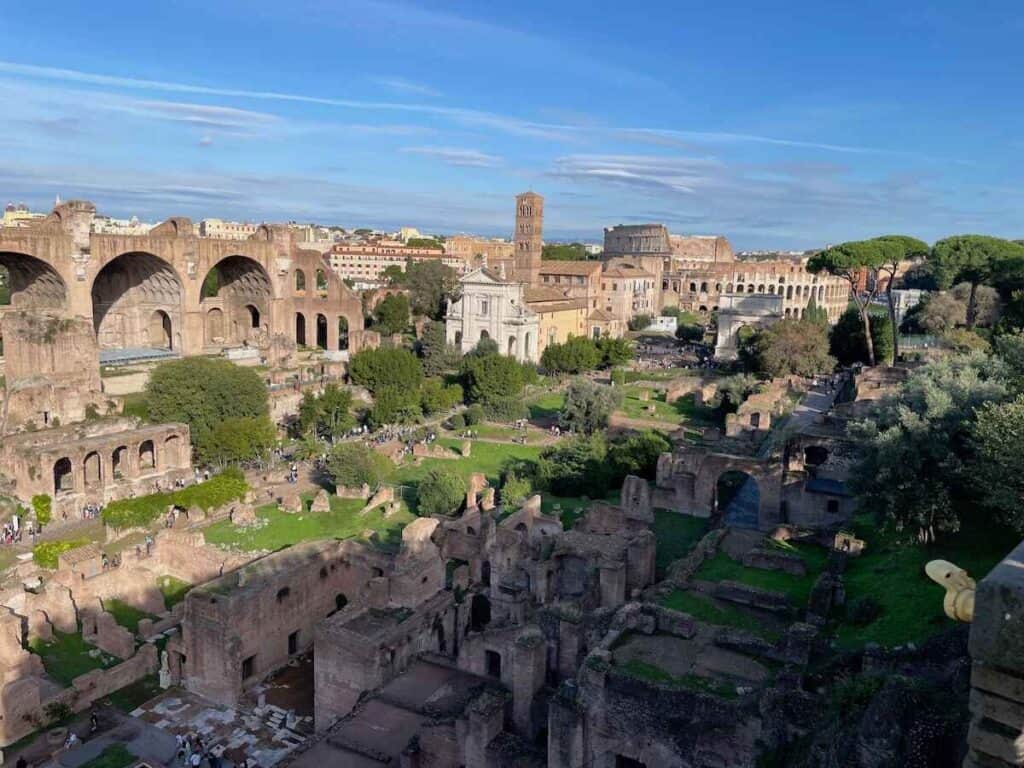
According to Roman mythology, Palatine Hill is where Romulus and Remus founded Rome.
It is one of the best viewpoints in Rome. From here you can see the Forum Romanum and Colosseum.
Remember to get a combo ticket, as it’s the best value for seeing all three attractions.
With views overlooking the heart of Ancient Rome, Palatine Hill also offers great photo opportunities.
Option: After visiting the Colosseum and Roman Forum you can take a detour to explore Monti, one of the city’s hidden gems and lesser visited neighborhoods.
This neighborhood offers cozy cafés and artisan shops.
⭐️ Read our first-time visitor guide to Rome so you don't miss out on the most important information and tips!
4. Piazza Venezia And The Altar Of The Fatherland

From the Roman Forum, follow the Via dei Fori Imperiali to reach Piazza Venezia.
This square is a hub from which important streets branch out.
The impressive structure on the Piazza is the Vittorio Emanuele II Monument, also known as the Altar of the Fatherland.
It was built in honor of the first king of unified Italy.
The name will likely be familiar to you from other cities, like Milan, with its famous Galleria Vittorio Emanuele II.
⭐️ Travel Tip: From the monument's terrace, you can enjoy a beautiful view of the city.
5. Campo de’ Fiori Market
Campo dei Fiori is one of the liveliest squares in Rome, especially from 8:00 AM to 1:30 PM.
During this time, a market takes place offering fresh produce, flowers, and local products.
6. Piazza Navona
Not far from Campo de’ Fiori is Piazza Navona.
The square is famous for Bernini’s fountains, including the impressive Fontana dei Quattro Fiumi.
Piazza Navona is surrounded by cafés and restaurants that invite you to linger, such as the famous Bernini restaurant.
Here, you can enjoy the lively atmosphere and admire the beautiful fountains.
⭐️ Tip: Piazza Navona is a worthwhile stop if you want to explore Rome at night, as the fountains are beautifully illuminated.
7. Pantheon

Next, head to the Pantheon, one of the best-preserved ancient Roman buildings.
Originally a temple dedicated to the gods, the Pantheon is now a church and the resting place of the famous artist Raphael.
A unique feature of the Pantheon is its gigantic dome with the oculus, a circular opening in the center.
Visiting this impressive structure is an absolute highlight.
⭐️ Good to know: Recently, a ticket is required to visit the Pantheon.
It’s best to purchase it from the official website, as other vendors charge significantly more for the ticket.
8. Trevi Fountain

The Trevi Fountain is one of the most famous spots in Rome and, along with the Colosseum, is among the top sights in Italy.
Legend has it that if you throw a coin over your left shoulder into the Trevi Fountain, you’ll return to Rome. (It worked for me!)
It looks especially magical at night when it’s illuminated.
Good to know: The Trevi Fountain is always crowded.
There are usually fewer people early in the morning and the evening, but it’s always busy.
⭐️ Insider tip and one of Rome’s hidden gems: in the area around the Trevi Fountain, you can visit the underwater city. We booked a guided tour here:
> GUIDED UNDERGROUND TOUR – TREVI FOUNTAIN AND UNDERNEATH THE DOMUS
9. Spanish Steps And Piazza di Spagna

Visiting the Spanish Steps, which lead from Piazza di Spagna up to the Trinità dei Monti church, is a must when in Rome.
The steps are one of the city’s most popular photo spots.
You’ll also find great shopping opportunities around the Spanish Steps.
⭐️ Good to know: don’t sit on the Spanish Steps during your visit. It’s prohibited and could cost you up to €450.
10. Piazza del Popolo And Sunset At Pincio Terrace

Piazza del Popolo is famous for its twin churches and Egyptian obelisk.
After taking a photo, head over to the Pincio Terrace, located on the edge of the Villa Borghese Gardens.
From here, you’ll enjoy a breathtaking view of Rome before heading off for dinner and then back to your accommodation.
For more ideas on exploring Rome’s top attractions, check out our Rome travel blog.
Day 2: Vatican City And Trastevere
Your second day in Rome takes you to the heart of Vatican City, followed by a visit to the charming Trastevere neighborhood.
Vatican City, St. Peter’s Basilica, the Vatican Museums, and the Sistine Chapel are among the top things to do in Rome.
1. St. Peter’s Basilica And St. Peter’s Square

Your second day in Rome begins with a Vatican City tour, which is actually its own city-state located within Rome.
It’s the seat of the Pope and the center of the Catholic Church.
St. Peter’s Basilica is the largest Christian church in the world.
Admission to the basilica is free, but the line can be very long.
A St. Peter’s Basilica visit is a must when exploring the Vatican City.
We decided to book a tour of St. Peter’s Basilica including the St. Peter’s dome climb.
This saves time, and from the dome, you’ll get an incredible view of the massive St. Peter’s Square and the city of Rome.
We booked our tickets here:
> TICKET FOR ST. PETER’S DOME, CRYPT & BASILICA
⭐️ Good to know: Plan to spend about 3 hours for this visit.
2. Vatican Museums And Sistine Chapel

A visit to the Vatican Museums is an absolute highlight of any trip to Rome.
They house one of the world’s most significant art collections, with the Sistine Chapel being the main attraction.
Here, you can see Michelangelo’s famous fresco, “The Creation of Adam.” Michelangelo worked in Rome and Florence—his renowned statue of David can be seen in the Galleria dell’Accademia in Florence.
We booked our tickets for the Vatican Museums and Sistine Chapel here:
> TICKET FOR THE SISTINE CHAPEL AND VATICAN MUSEUMS
⭐️ Good to know: Plan to spend at least 3 hours here as well.
Alternative option: If you have time in the afternoon, consider visiting the Borghese Gallery and Gardens.
The Borghese Gallery is home to an impressive collection of Renaissance art.
After exploring the gallery you can enjoy a walk through the Villa Borghese gardens.
3. Castel Sant’Angelo And The Angel Bridge

Just a short walk from the Vatican are two more of Rome’s landmarks: the impressive Ponte Sant’Angelo (Angel Bridge) and Castel Sant’Angelo (Castle of the Holy Angel).
Originally built as a mausoleum for Emperor Hadrian, Castel Sant’Angelo later served as a fortress and refuge for the Popes.
It’s worth climbing to the top of the castle for a beautiful view of the Tiber River and Rome.
The castle is connected to the opposite riverbank by the Angel Bridge, which, as the name suggests, is decorated with angel statues and is a popular photo spot.
⭐️ Good to know: You can visit Castel Sant’Angelo, but you’ll need a ticket. It’s best to book this in advance as well.
For a more in-depth itinerary about the Vatican, you can read our itinerary for three days in Rome.
4. Trastevere

Spend the late afternoon and evening in the Trastevere neighborhood.
This area is known for its narrow streets and cozy restaurants.
Here, you can experience authentic Roman life.
Trastevere is also the perfect place to enjoy a traditional Roman dinner at one of its many restaurants.
One of the main sights here is the Basilica of Santa Maria in Trastevere, one of the oldest churches in Rome, famous for its stunning mosaics.
You can end your second day in Rome with a food tour in Trastevere.
It’s a great way to try local cuisine and sample specialties like fried artichokes and rice balls.
After your visit to Trastevere, you can enjoy a night walk along the Tiber River before heading back to your hotel.
Essential Tips for Getting Around Rome
- Book tickets in advance: Especially for the Colosseum, Roman Forum, Vatican Museums, Sistine Chapel, and St. Peter’s Basilica. Buying tickets online ahead of time not only helps you avoid long lines but ensures you can actually visit these popular attractions.
- Book your accommodation early: Find out more about where to stay in Rome including top picks from budget to luxury.
- Comfortable shoes: Rome is best explored on foot, so be sure to pack comfortable shoes.
- Start early: Many attractions are less crowded in the early morning, giving you more time to explore and take photos during your 2 days in Rome.
- Dress appropriately: For St. Peter’s Basilica and some churches, you’ll need to cover your shoulders and knees to enter (women and men).
- Photo ID required: For certain sights, like the Colosseum, you’ll need to show a photo ID. Make sure to bring your passport or ID card.
- While Rome is a year-round destination, it’s worth noting that the worst time to visit Rome is during the peak summer months.
For more essential tips for your visit to Rome, check out our Rome travel blog.
Public Transportation in Rome: What You Need to Know
Rome has a public transportation system, but it’s not as extensive as in other major cities.
Three main metro lines in Rome connect the most important parts of the Eternal City.
However, the metro is limited, especially in the Centro Storico (historic city center), where many of the must-see attractions are located.
In addition to the metro, there is an extensive bus network.
The buses run regularly, but during peak times, traffic can cause delays.
Our tip: Take Bus 64, which connects some of the most famous attractions, such as St. Peter’s Basilica in Vatican City, Rome’s city center, and Termini Station.
A popular alternative is the Hop-on Hop-off Bus.
This offers a convenient way to reach Rome’s main attractions without having to worry about schedules or complicated routes.
The bus stops at major landmarks like the Colosseum, St. Peter’s Basilica, and the Spanish Steps, allowing you to hop on and off to explore Rome at your own pace.
This bus conveniently starts at the main train station Roma Termini. It’s a perfect starting point for your two days in Rome, and the area where we stayed during our last trip to the Eternal City.
Tips for Using Public Transportation:
- You can buy bus and metro tickets at machines in metro stations, as well as at tobacco shops and kiosks.
There are day and multi-day passes, which are especially recommended for weekend trips. - During peak hours, plan extra time for your trips, as buses are often delayed.
- A Hop-on Hop-off Bus ticket is a great option if you want to travel stress-free from one attraction to the next.
It’s also perfect for taking photos of the landmarks from an elevated position on the bus.
Final Thoughts About The 2 Day Rome Itinerary
While two days in Rome may seem short, with our well-thought-out and planned itinerary, you can experience the city’s most important attractions.
From the ancient ruins of the Colosseum to the art treasures of the Vatican, and the stunning fountains—Rome is sure to leave a lasting impression on you.
We’ve got even more tips to help make your trip to Rome, one of the best cities to visit in Italy for the first time, unforgettable.
Check out our Rome tips here: Rome travel tips